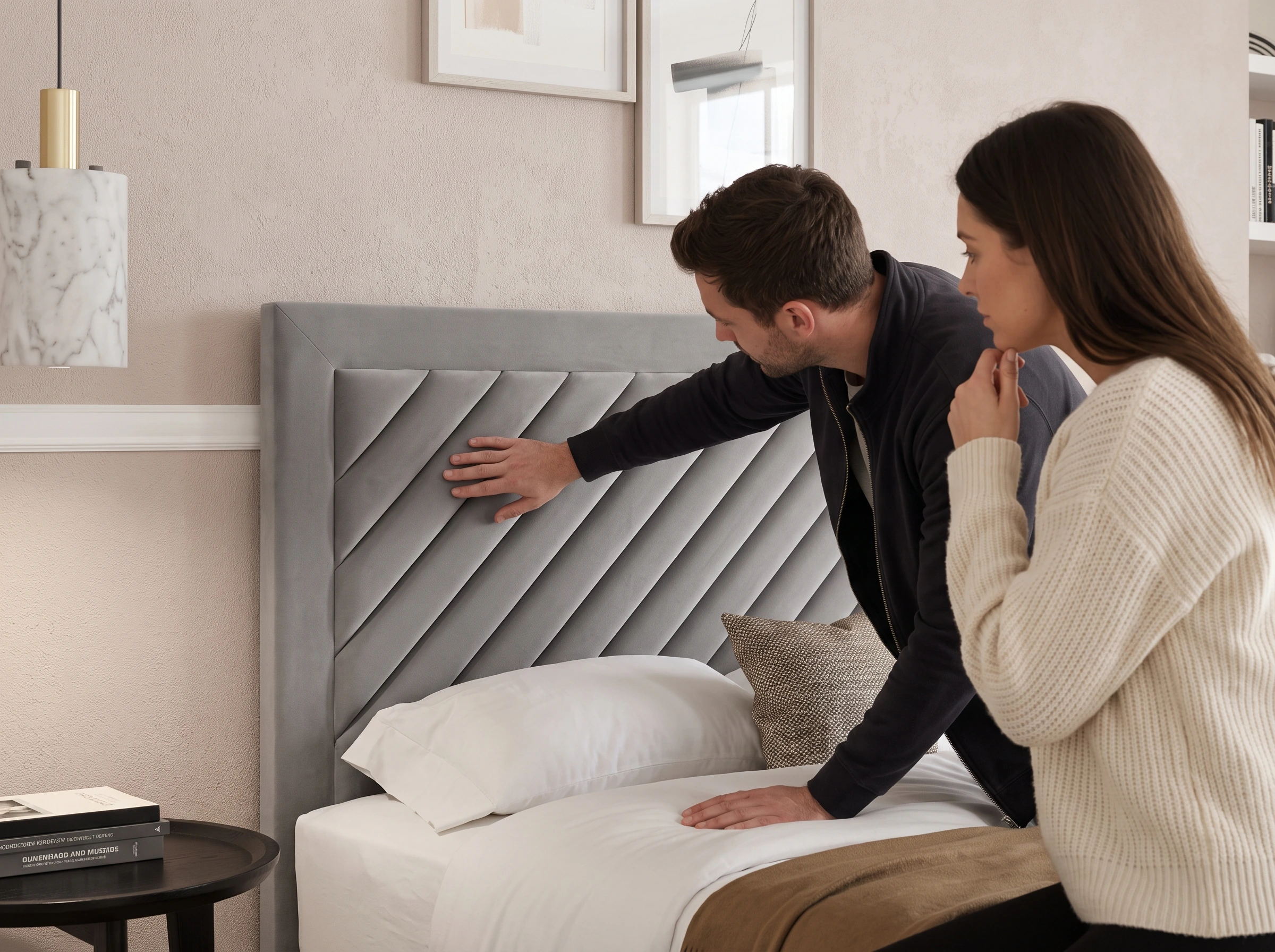
Low headboards are well worth considering when a window sill, sloping ceiling, or awkward wall space limits where your bed can go. However, simply choosing the shortest headboard option will not solve every challenge. Overall width, total depth, and clear access to nearby fittings matter just as much.
At The Bed Village Yorkshire, we always recommend measuring and checking the physical space behind your bed before settling on a style. Here is how to compare a lower-profile design with a taller headboard to work out what will genuinely fit your room.
Start with the Space Behind Your Bed
A tall headboard can work brilliantly even in a compact bedroom, provided the wall behind it is completely clear. Conversely, a lower design becomes far more practical when a taller panel would obstruct an inward-opening window or sit awkwardly close to a sloping ceiling.
It is essential to keep physical fit separate from visual appearance. While a shorter headboard leaves more wall space visible, it does not automatically reduce the actual footprint or floor space the bed frame takes up.
While there are several benefits of incorporating a headboard into your bedroom design, your main priority here should be ensuring the overall dimensions fit comfortably where you intend to position the bed.
Measure Low Headboards from the Right Starting Point
Check What the Listed Height Means
Before comparing measurements, check exactly what each figure describes:
- Panel height: the height of the headboard panel itself, from top to bottom.
- Installed height: the total distance from the floor to the very top of the headboard once fully installed.
- Visible height: the amount of upholstery that actually shows above your mattress.
These figures answer very different practical questions. Floor-to-top installed height helps you check whether the headboard will clear a low window sill or sloping wall, whereas visible height shows how much decorative fabric will remain on display above your mattress.
Our divan listings include options labelled “24-inch headboard” and “54-inch floor-standing headboard”. Never assume both heights are measured from the same starting point. Always ask us to confirm the exact installed dimensions for your chosen combination of bed base and headboard before ordering.
Map the Available Space
Sketch out the wall behind the bed and mark any window sills, electrical sockets, light switches, and sloping ceilings. Measure carefully from the floor up to the window sill or ceiling above the bed’s intended position, then compare those dimensions directly with your headboard’s confirmed installed height.
Check the headboard’s full width and how far it projects forward into the room, factoring in any decorative wings or curved upholstery detailing. If you are fitting the bed beneath a sloping ceiling, always check the available headroom and height across the entire width and depth—not just at the centre.
Remember that skirting boards, trunking, or projecting wall fittings can affect how flush the bed frame sits against the wall. If your wall surface permits, try using low-tack painter’s tape to mark out the headboard’s physical outline on the wall before making your final purchase.
With your measurements safely to hand, explore our collection of divan bed options and feel free to ask us to confirm the exact installed dimensions of your shortlisted headboard style.
Choose Around Your Room’s Main Obstruction
Beneath a Window
Placing a headboard under a window requires more than a simple sill-height measurement. Turn the handle, open the window fully, and draw your curtains or blinds as you normally would. Check whether the curtain fabric will hang freely behind the panel or become trapped awkwardly against it.
A low-profile headboard may sit neatly beneath the sill, but it could still obstruct a window handle or heavy curtain fold. If the headboard prevents you from opening or using the window properly, it is far better to reconsider the bed’s position rather than accept restricted access and poor ventilation.
Beneath a Sloping Ceiling
When positioning a headboard beneath a sloped roof or eaves, measure the available height across its full width. Depending on the angle, there may be significantly more height at the centre than at the outer corners, or vice versa.
Depth matters just as much as height. A thick, padded upholstered panel extends further into the room, where the ceiling height may be noticeably different from the wall face. Mark exactly where the front corners and back edge of the headboard will sit. Do not forget to consider your upright sitting position in bed when deciding whether the slope provides adequate headroom.
Around Sockets, Switches, and Wall Fittings
Keep everyday controls, switches, and sockets easily reachable. Always allow extra clearance for plugs and bends in charger cables—not just the flat face of the socket—and avoid trapping electrical leads tightly behind the headboard.
Never improvise electrical alterations or modify switches just to force furniture to fit. If a socket or light fitting genuinely needs relocating, always seek qualified advice from a registered competent electrician. Likewise, if a radiator or vent restricts where the bed can stand, follow the specific clearance guidelines for that fixture rather than guessing how much space to leave.
Check the Rest of the Bed Still Works
Headboard clearance is only one part of your room’s overall layout. Always check the frame’s total length and width, particularly when comparing bed models with or without matching footboards. When choosing beds for small spaces, you must also leave sufficient room to open storage drawers fully and walk around the bed comfortably.
Imagine a spare room where the bed stands beneath a window and a wardrobe sits adjacent to it. A shorter headboard might leave the window sill completely clear, but the bed’s integrated side drawers could still catch on the wardrobe door or base. When choosing a guest bed, check both clearance factors together before settling on a base type.
If lift-up storage looks like a more suitable option, compare our ottoman divan beds and confirm how much vertical space the mechanism requires to open fully—especially if placing the bed beneath a sloping ceiling or low eaves.
Once you are confident the physical layout works, you can turn your attention to the visual finish. Use our comprehensive bed fabric guide to help you choose a texture and colour that complements your decor, while understanding the ongoing upkeep and care required.
Confirm These Details Before Ordering
Before placing your order, send us your room measurements, the exact model name, and your selected customisation options. Ask our team to confirm:
- Floor-to-top installed height, full width, and overall depth.
- What the advertised headboard measurement specifically refers to (e.g., panel height versus installed height).
- Fixing requirements and headboard compatibility with your selected base type.
- Overall bed dimensions and the precise clearance space needed to open any integrated storage drawers or ottoman lift mechanisms.
A product photo alone cannot answer these measurement questions. Always rely on confirmed, exact measurements before committing to positioning a bed beneath a window sill, sloping ceiling, or tight alcove.
Frequently Asked Questions
Can I replace my headboard without replacing the bed base?
Possibly, but always check compatibility first. Confirm how the new headboard attaches to your existing base, check the fixing hole distances, and ensure the replacement is suitable before purchasing it separately.
Can a floor-standing headboard be used without wall mounting?
Always follow the specific assembly and securing instructions provided for that model. The label “floor-standing” alone does not tell you how the headboard must be attached or supported.
Can I lower or shorten an existing headboard?
Only make adjustments that are explicitly approved by the manufacturer for that model. Always contact the maker before attempting to modify a headboard; cutting down the panel or altering its fixing brackets is not a routine or safe way to make a headboard fit your room.
What if the headboard fits the room but not the staircase?
Compare the packaged or delivered panel dimensions with your entrance doorways, stairwell clearances, and any tight corridor turns before ordering. Always check whether partial disassembly is permitted or designed into the model rather than assuming a large headboard panel can be taken apart.
Does a low headboard automatically cost less?
Not necessarily. Compare the full combination of bed base and headboard rather than assuming overall height dictates price. Upholstery fabric choices, tufting detail, bed frame size, and included storage options may all affect the overall cost of the models you are considering.
Need Help Choosing a Headboard That Fits?
Choosing between a tall and low headboard starts with assessing the space behind your bed. If a window sill, sloping ceiling, or nearby wall fitting limits your options, always check the confirmed installed height, full width, and depth before deciding on a final style.
At The Bed Village Yorkshire, we can help you compare bed and headboard options with confidence. Have your room measurements and shortlisted model names to hand, and ask us to verify the exact dimensions and fixing requirements for your chosen combination. That way, you can check the fit without relying on product photos alone.
For expert advice before placing your order, contact us today, call 0800 844 5982, or email [email protected].