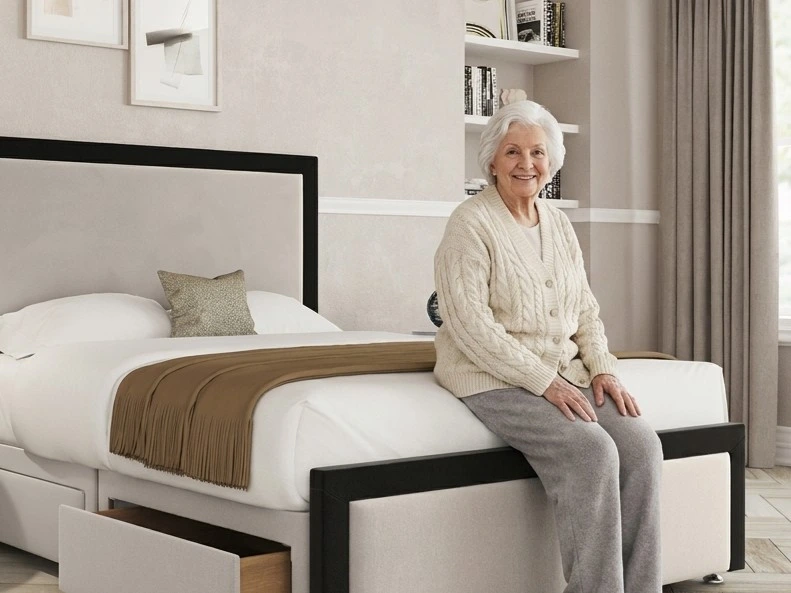
Choosing the best bed for elderly people starts with one practical question: can the person sit down, stand up, turn, and rest without strain? A bed can look beautiful in the room, but if it sits too low, dips at the edge, or forces the user to push through sore hips and knees every morning, it is not doing its job.
At The Bed Village Yorkshire, we speak to many families who want a safer bed for an older parent without making the bedroom feel clinical. That is a fair concern. A good standard divan bed, paired with the right mattress, can often give the right mix of support, comfort, storage, and style. The key is choosing the setup by how the person actually moves, not only by size, colour, or price.
The Popliteal Height Benchmark
Start with the popliteal height benchmark. Popliteal height means the distance from the floor to the underside of the knee when someone is sitting with their feet flat. In plain terms, the bed should let the user sit with knees close to a right angle, feet planted, and hips level or slightly higher than the knees.
This matters because standing from a very low bed asks more from the thighs, hips, and knees. A bed that is too high creates the opposite problem. The person may perch on the edge, slide forward, or struggle to place both feet securely on the floor.
Here is the usable test:
- Sit on the bed edge with normal slippers or indoor shoes on
- Check whether both feet rest flat on the floor
- Look at the knees; they should not be sharply raised above the hips
- Ask whether standing up feels smooth or whether the person needs to rock, pull, or push hard
- Check the same movement when tired, not only when feeling fresh
A standard divan base plus mattress can work well when the mattress is chosen with the right depth for the user. If the base is already a comfortable height, avoid choosing a very deep mattress unless the user can still sit safely with both feet flat on the floor.
Suggested read: What the Trends Say: Are Divan Beds Old-Fashioned?
Why a Solid Divan Base Often Feels Safer Than Slats
Older users often rely on the bed edge more than they realise. They may sit there to put on slippers, steady themselves before standing, or pause before walking to the bathroom.
A solid divan base provides a firm, non-yielding platform under the mattress. Compared with some slatted frames, it can reduce the bounce or dip at the side of the bed. That steadier edge helps the user stabilise before standing, especially if they have stiff knees, reduced balance, or general morning aches.
This does not mean every slatted frame is unsuitable. Sit on the edge and shift your weight slightly. If the mattress rolls, the frame flexes, or the edge feels unstable, keep looking. We usually suggest pairing a supportive divan with a mattress that holds its shape at the sides, because the base and mattress need to work together.
The Mattress Matters As Much As The Bed Frame
The right bed height will not make up for poor mattress support. An elderly person needs a mattress that supports the spine, cushions pressure points, and still allows easy movement. Too soft, and the user may sink in, twist awkwardly, or struggle to turn. Too firm, and shoulders, hips, and joints may feel sore.
Pocket spring mattresses are often a strong option because each spring responds more independently to body weight. This can improve contouring and support without creating the “stuck” feeling some people get with very soft mattresses. For couples, pocket springs can also reduce movement transfer, which helps if one person gets in and out of bed more often during the night.
A practical mattress check should include:
- Can the person roll from back to side without effort?
- Does the edge feel secure when sitting?
- Are hips supported rather than sinking?
- Do shoulders feel cushioned when lying on the side?
- Is the mattress easy enough to rotate, if rotation is required?
For more detail on spinal support, our guide to the best mattress for good posture explains what to look for when comfort and alignment both matter.
The NHS also gives practical advice on making daily movement safer at home, including reducing trip risks and thinking carefully about furniture layout. For older people, the bed should be part of that wider safety picture, not an isolated purchase.
Choose Headboards and Footboards for Access
For elderly users, we usually avoid recommending high, hard wooden footboards. They can restrict leg movement, make it harder for a caregiver to help with bedding, and create an extra obstacle at the end of the bed. A hard corner at shin height is not ideal in a room where someone may walk slowly, turn carefully, or get up in low light.
A low-profile, soft-padded upholstered footboard is often the better compromise. It keeps the bed looking complete, helps stop bedding from slipping, and feels less harsh if someone brushes against it.
If a footboard is important for the room design, compare the height against the user’s normal movement. Can they walk around the bed without catching their legs? Can bedding be changed easily? Can a relative or carer stand at the end if help is needed? Our range of beds with footboards can help you see the difference between decorative styles and more practical, low-profile options.
The headboard deserves the same attention. A padded headboard can make sitting up more comfortable for reading, watching TV, or taking medication. It also gives the bed a finished look without adding a hard barrier at the foot. If that is a priority, our guide on why a bed with a headboard can help you think through comfort and bedroom style together.
Storage Should Reduce Bending, Not Add Another Risk
Storage beds can be useful for older people, but only if the mechanism is easy and safe to use. The aim is to keep spare bedding, pillows, or seasonal items within reach without repeated bending to floor level.
Smooth gas-lift ottoman beds can work well because the mattress platform lifts, bringing the storage area into view without needing to bend down to floor level. The lift should feel controlled, steady, and easy to manage, especially if the bed will be used for spare bedding, pillows, or seasonal items. If the user has reduced grip strength or shoulder discomfort, a relative or caregiver can handle the lifting while still keeping storage neatly tucked away and easy to access.
Room layout matters too. Ottoman beds need enough space for someone to stand safely while lifting. Avoid storage that makes the person twist, bend low, or pull hard from an awkward angle.
In smaller rooms in Dewsbury, Wakefield, Leeds, Bradford, Huddersfield, and nearby West Yorkshire areas, storage is often a real issue. Our guide to how ottoman beds solve storage problems may help if you want a safer way to keep bedding close without cluttering the floor.
A Simple In-Store Checklist Before You Buy
A bed for an elderly person should be tested slowly. There is no need to rush the decision.
Use this checklist:
- Sit on the edge for at least a minute
- Stand up without using momentum
- Lie down and turn onto each side
- Sit back up and check whether the edge still feels secure
- Test the headboard position if the person sits up in bed
- Walk around the bed and check for tight gaps
- Lift the storage exactly as it would be used at home
Try not to choose only what looks safest to you. Ask what feels comfortable, dignified, and familiar to the person using it. A bed that feels too medical may be disliked, even if it is technically practical. A supportive divan with a good pocket spring mattress, soft upholstery, and sensible storage can feel reassuring without changing the bedroom’s character.
Frequently Asked Questions
What is the best bed height for an elderly person?
The best height is usually the one that lets the person sit with feet flat and knees close to a right angle. Use the popliteal height benchmark rather than guessing from a product photo, because mattress depth can change the bed’s total height significantly.
Are divan beds good for elderly people?
Divan beds can be a good choice because the base is stable, compact, and easy to pair with different mattress depths. A solid divan base can also provide a steadier sitting edge than some flexible frame styles.
Should elderly people use a firm mattress?
Not always. The mattress should be supportive rather than simply firm. Many older sleepers need enough cushioning for hips and shoulders, with enough structure to stop the body from sinking too far.
Are ottoman beds safe for older people?
Ottoman beds can be safe when the gas-lift mechanism is smooth, controlled, and easy for the user or a caregiver to manage. If lifting feels awkward, it is best for a relative or caregiver to handle the storage access.
Is a footboard a bad idea for an elderly person?
A high, hard footboard can restrict movement and create a bump hazard. A low, padded upholstered footboard is often a more practical option if the user wants the bed to look finished without limiting access.
Create a Safer, More Supportive Bed Setup
If you’re choosing a bed for yourself or helping an elderly parent, we can talk you through the options without pressure. We’ll help you compare divan bases, pocket spring mattresses, headboards, footboards, and storage options to suit the person’s mobility and the room.
Our bed specialists are just a message away. You can reach us by email at [email protected] or call us at 0800 844 5982.