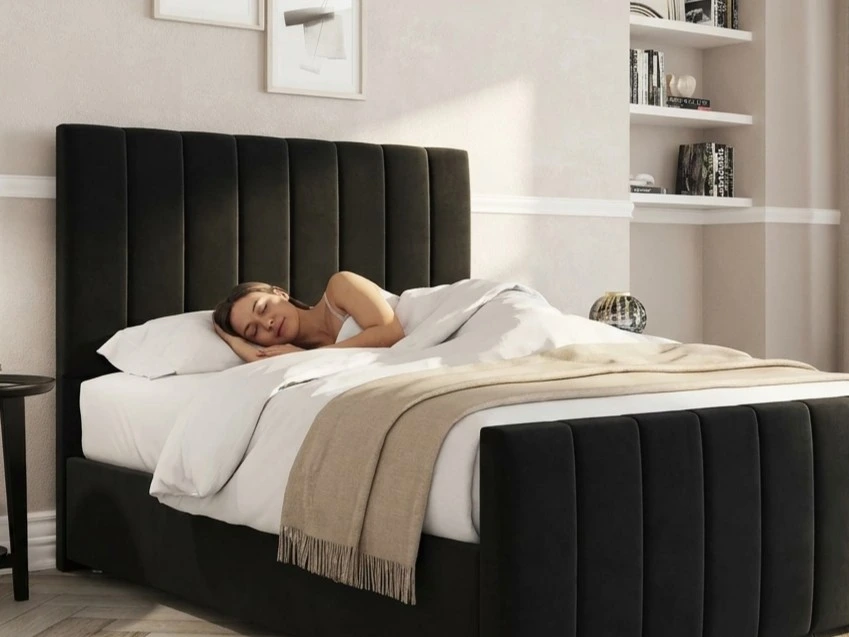
The best mattress for good posture does more than feel comfortable for the first few minutes in a showroom. It keeps your ears, shoulders, hips and ankles in a natural line, so your muscles are not spending the night trying to protect a spine that is dipping into the wrong position.
That is the part many people miss. A mattress can have excellent materials, a high price and all the right labels, but if it is placed on a tired slatted base or an uneven frame, it may still fail your back.
Spinal Alignment Matters More Than Softness
A soft mattress can feel lovely for ten minutes, but that does not mean it will support your posture for seven or eight hours.
Good sleep posture keeps the body’s main weight points supported without forcing the spine into a curve. Your shoulders and hips need enough cushioning to settle, but your lower back still needs firm, even support. If the middle of the body drops too far, the spine can settle into a shallow “U” shape. If the surface is too hard, the body may twist away from pressure points instead. That constant correction matters more than you think.
It is easier to get deeper rest when the muscles are not bracing, guarding, or compensating. If your lower back is working all night because the bed is sagging under your hips, you may wake up stiff even if you technically slept long enough.
This is why “comfortable” is too vague a standard for a good mattress. The better question is whether the mattress keeps your body in a steady, neutral position once your full weight has settled into it.
The Mattress and Base as One Unit
The mattress gets most of the attention, but the base underneath can also make or break the result. Even a high-quality orthopaedic mattress needs an even foundation. Put it on a bowed frame, wide-gapped slats, or a base with weak spots, and the mattress cannot work as intended. In our experience, customers often blame the mattress, while the real problem is the base quietly undermining it.
This is one reason we often talk to customers about whether divan beds are better for your back. A stable divan base can give the mattress a more consistent platform, helping the support layers do their job properly.
A simple check helps: look across the base without the mattress on it. If the slats are uneven, cracked, widely spaced, or dipping in the middle, a new mattress may not solve the problem on its own.
Why Independent Pocket Springs Are So Useful for Posture
Independent pocket springs are hard to beat for spinal health because of how they respond to pressure. Instead of one connected spring unit pulling the body into a hammock shape, each pocket spring compresses only where support is needed.
That delivers a few practical benefits:
- Better contouring around the lumbar arch: Each spring sits in its own fabric pocket, so the mattress can support the lower back without forcing the whole surface to move at once.
- More balanced pressure relief: Shoulders and hips can settle into the mattress while lighter areas stay supported.
- Less roll-together: Because the springs move separately, pressure from one sleeper is less likely to drag the other side of the mattress down.
- A cleaner support line: The mattress can take deeper pressure at certain points without letting the whole body dip.
Linked open-coil systems behave differently because the springs are connected. Pressure in one area can affect a wider section of the mattress, which can create a hammock effect over time.
Independent pocket springs are not magic by themselves. Spring count, tension, upholstery layers and the base all matter. If you want to compare options, start with our Dream 1000 pocket sprung mattress and 2000 pocket mattress, or look at our orthopaedic mattress and deluxe orthopaedic mattress for firmer support.
Signs Your Current Mattress Is No Longer Supporting You
Morning stiffness is one clue, but it is not the only one. If you feel better after moving around for half an hour, your bed may be aggravating pressure overnight. If you regularly wake up with sore shoulders, hip discomfort, or tightness in your lower back, your mattress might be allowing certain areas to sink too far. Visible dips and rolled edges are also strong signs that your mattress has failed.
Your sleeping position can also tell you something. If you keep shifting to find a tolerable spot, your sleep becomes lighter and more broken. This does not always lead to pain or discomfort, but you may still wake up feeling restless, as if you are about to overheat, or simply tired for no clear reason.
We have a fuller guide on the signs you need a new mattress if you are trying to work out whether the problem is age, support or simply the wrong tension.
Suggested read: Is a Good Mattress Worth It? Why It Could Be Life-Changing
What to Ask Before Buying
Ask what the mattress is doing under load, not just what it is made from.
- Does it use independent pocket springs or a linked spring system?
- What tension is suitable for your body and sleeping position?
- Is the comfort layer there to relieve pressure, or is it so deep that your hips may sink too far?
- Will the base provide even support across the whole mattress?
Also ask whether your current frame is still fit for purpose. If a slatted base is uneven, damaged, or too widely spaced, the most sensible purchase may be a bed-and-mattress system rather than a mattress alone.
We are not trying to upsell you. We want you to avoid the common mistake of putting a well-built mattress on a weak foundation and expecting it to behave like it is on a proper platform.
FAQs
What type of mattress is best for good posture?
The best choice is usually a mattress that combines pressure relief with stable support, often through independent pocket springs and suitable comfort layers. The right firmness depends on your body weight, sleeping position and base, so it should not be chosen from a generic firmness chart alone.
Is a firm mattress always better for back pain?
No. A mattress that is too firm can put pressure on the shoulders and hips, causing the spine to curve unnaturally. On the other hand, a mattress that is too soft can let the pelvis sink too far. Aim for a supportive middle ground.
Can a bad bed base cause back pain?
Yes. An uneven or damaged base can make the mattress compress inconsistently. Wide slat gaps, bowed slats, or weak centre support can create dips that pull the spine out of alignment, even if the mattress itself is good quality.
Are pocket springs better than open-coil springs?
For posture support, pocket springs are often better because each spring responds independently to your body. Open-coil systems are linked together, so movement and pressure can spread across the mattress and create a hammock effect over time.
How do I know if my mattress is causing morning stiffness?
Look for patterns. If stiffness is worse when you wake up and eases after you move around, your bed may not be supporting you properly overnight. Visible sagging, soreness or mild discomfort on waking, and needing to change positions throughout the night are also strong warning signs.
Speak to Us About a Mattress Built for Your Body
If you are tired of guessing which mattress tension suits your sleeping style, speak to our specialists at The Bed Village Yorkshire today. We can discuss where you feel pressure, how you sleep, and whether your current base is helping or hurting the mattress above it.
Our bed specialists are just a message away. You can reach us by email at [email protected] or call us on 0800 844 5982.